- One Hundred Aspects of the Moon (Yoshitoshi...1839-892)

Poet/Artist Bernadette Mayer took a roll of pictures each day for a month in 1971 and wrote a diary to accompany it… (New Yorker article)
bike lights
E-Cargo bikes review
What I hear from people who have bought them is that they change life in small but profound ways. Such an e-bike becomes a family adventuremobile for exploring greenways and parks; kids ask to go to school on the “big bike,” not in the car; running errands becomes something other than sitting in stressful traffic and hunting for parking spaces. Life seems simpler. The point of cargo bikes isn’t to get a workout (ahem, e-bike shamers). And while they can replace a car outright, that’s a commitment few are willing to make. Really, these bikes are meant to replace car trips—as many as you can feasibly switch from four wheels to two. That means they’re among the most important kinds of bikes to make and sell.
26 tips on healthy eating (Outside)
Backpack essentials (Outside)
- 5 minutes to fall in love with violin (there are other “5 minutes” for other topics like modern music)
- I’m guessing that many teachers are now moving towards planning for bigger assessments and thinking more intensely about how remote learning makes us think about grades a little differently. We spoke last week at the department meeting about some of the issues with grading and assessment in a remote setting. Here’s an addendum to that conversation: a blog post by Kittle and Gallagher (180 Days…) that reiterates their 7 principles of grading and how remote learning impacts that. I found the posting wise and helpful. It may give us all some ideas to consider and/or some language to use with admin or parents. Their last question is an important one. link
Friday, September 4, 2020
10 Things -- not strictly school related - that came across my desk this week

Gallagher and Kittle on Grading during remote learning
Here's the whole post: https://blog.heinemann.com/reflections-on-grading-from-180-days
Here's my favorite part:
Let’s be clear: More grading does not mean better teaching is happening or that learning is occurring. Grades sort winners (As and Bs) from losers (Ds and Fs), but they don’t make our students better readers and writers (and in some cases they impede their progress). Today’s students are tested (and graded) more than ever, yet one in four who make it to college will be enrolled in remedial courses. Nearly half of these students hail from middle- and upper-income families, dispelling the widely held belief that only low-income or community college students are saddled with remedial courses (Education Reform Now 2016). Today’s students—perhaps more than any other students—have been graded and graded and graded, yet their reading and writing skills are not strong enough for college success. Voluminous grading of crappy writing (often essays about fake reading) does not change the fact that the writing is still crappy.
Given the political worlds in which we teach, we must assign grades, but thoughtful planning about how, what, and why we’ll grade is essential if we want our students to become better readers and writers.
We share seven principles of grading that inform our work and make grades as meaningful as possible. These seven principles can still guide grading during the pandemic:
- Students Need a Volume of Ungraded Practice
- Students Need Practice in Reading Like Writers
- Students Need Feedback
- Not All Work Is Weighted Equally
- Grades Should Tell the Truth About Progress
- Rubrics Are Problematic
- Best Drafts Receive Limited Feedback.
These principles, some perhaps surprising, help us concretely connect the actual progress students make—the work they are doing day in and out—to the letter on their report cards, and these principles are important no matter the instructional setting.
We show exactly how we put these principles into action across the most important work students do in our English classrooms. We also show how we set up our grade books. We close this chapter with the following.
Our mantra in a profession dedicated to the love of reading and writing should be to embrace experimentation and practice—lots of both—and to minimize, shrink, reduce, and if we had our way, eliminate grading. The increase in testing in the last decade has been considerable—anyone who has been in teaching that long has seen it happen—but the 2012 National Assessment of Educational Progress (NAEP) results show that even with all of that grading, there has been no significant increase in proficiency. These results remind us of a farmer’s wisdom: you don’t fatten a pig by weighing it. Grading is not worth all the energy it steals from us.
Evaluation and testing eat up time that is better spent reading, writing, and talking. We steal time from our daily essential practices with students to measure their progress. We steal time from our own reading and writing in order to mark those tests and submit those grades. Worry about performance inhibits creative thinking and leads writers to choose the easiest path to finish. In contrast, expansive thinking develops over time. Constant evaluation teaches students to be dependent on a teacher’s judgment, instead of their own.
We worked hard to try to find the proper balance between the evaluation required of us by our schools and the authentic practices we believe are essential in building literate students. And whenever we felt that balance getting a bit out of whack, we stopped and asked ourselves, “Is this grading practice getting in the way of our students’ improvement?”
That last sentence poses a question we always struggle while planning for our first meeting with students. During this pandemic, with shortened instructional time, our grading practices must encourage our students, not impede their growth. Because in the midst of working with several dozen tweens or teens at a time, trying to squeeze time in for them all, and managing curricular expectations, it’s easy to lose sight of the big goal: helping kids make progress toward a lifetime of reading and writing
Thursday, August 27, 2020
10 Tips for Fostering Effective Online Discussions (from JHU)
Ten Tips for Foster Effective Online Discussions
from Johns Hopkins link
Monday, August 24, 2020
Crowd Source: How do you take attendance during remote learning?
Teachers answered this question:
One of your colleagues would like to know: how are you taking attendance? Please share what technique/s you've come up with so far!
- I am using the Zoom report at the end of class. It is the most efficient because it tells you what time kids logged on/off of the meeting, so you know if someone left early. It can be done easily after class is over.
- I'm using Zoom. But instead of looking at the report through Zoom, I've used the excel rosters they sent me to print alphabetically by first name rosters. Since Zoom lists participants by first name, it's fairly easy to find out who I'm missing that way, especially when you know how many your have by the participant list (Zoom counts the teacher, so you have to subtract 1.)
- I take attendance as I let them into class from the waiting room. It takes a tad bit more time, but until I know everyone, it has been working. If I need to double-check, I can look at Zoom attendees like Kim taught us in the video.
- If my class plan involves everyone sharing something out, I will take attendance when they speak; if all kids won't be speaking, I will use a question to start class and collect responses.
- I am simply taking attendance during the bell-ringer.
- I have been using Zoom so far, but I also sent the students a Google Form like the one we used last spring, just in case.
- I'm taking attendance with bell ringers/roll call get-to-know-you questions at the start of each class, but I also made a Google Form just for bookkeeping.
Friday, August 21, 2020
Question to teachers today: Thursday and Friday are the first days of 75-minute classes. How is that transition in planning going so far?
Here's what teachers have said after the abrupt transition to "remote" and "block" both at once:
Smoother than I expected during class with kids. Harder than I expected in planning for it.
Ok! I've learn d that asynchronous work for most (on GoGuardian) while working with a small learning group on Zoom -- that is going to be my default.
I like the 75-minute class period, but I found I planned too much. I need to adjust my expectations for the virtual environment because transitions take longer.
Fine. I over-planned but have adapted. Students preferred the 75-minute classes and time went by quickly.
Again, I wish we could have had some more formal training about this. But, this is so much better than hybrid. This is more instructional time than hybrid, and it provides stability of planning. Please, please, please convey this to the higher ups who are thinking of jumping back and forth between this and hybrid.
My general experience so far has been that I've spent more time figuring out and trouble shooting Zoom, Canvas and other delivery methods than I have on content, which is especially frustrating since I am teaching a new prep. Between the two new things, I'm about as overwhelmed as I've been in 24 years of teaching.
The class periods themselves are much nicer than rushing through an entire school day with short periods. It seems much more civilized.
The feedback from kids has been positive so far when I have checked in with them about how things are going. Many kids indicate that they like the flexibility of remote learning and that they feel less stressed than they normally do at school. Especially the honors students. They do concede to missing being in the classroom, but this definitely could bode well to offering a blended model someday when we aren't living in this nightmarish state.
I love the 75-minutes classes! It gives time to build relationships, introduce concepts, have students apply them, and provide coaching (both collective and holistic). My students are also saying they like the schedule of Block. They feel like they have time to process all that's been taught, get a pause, and then geared up for the next class. Sort of reminds me what is good about college, which is also good for students since we should be working to transition them to a schedule that requires time-management. The only thing I need to adjust for next week is to avoid going over the 75 minutes, to be respectful of their time. (Oops.)
Wednesday, August 19, 2020
What to say when... you've been called out for a micro-agreession
What to say when... you've been called out for a micro-aggression.
This is from a Harvard Business Review Management tip of the day:
|
It was a throwaway remark, and you didn’t mean to offend. But
now that a colleague has brought the slight to your attention, you realize
what you said was hurtful. So how should you respond after committing a
microaggression? First, make sure the other person feels heard. Your instinct
may be to defend yourself — or your comment — but this isn’t about you. You
can be a good, well-intentioned person who said something offensive. Follow
your colleague’s lead in the conversation, and be curious and empathetic.
Offer a sincere apology that expresses gratitude for their trust and
acknowledges the impact and harm your comment caused. Say something like:
“Thank you for telling me. I appreciate that you trust me enough to share
this feedback. I’m sorry that what I said was offensive.” Be sure to keep it
short and to the point. Don’t over-apologize or try to engage your colleague
in a drawn-out conversation. Finally, commit to doing better in the future.
Say, “I care about creating an inclusive workplace, and I want to improve.
Please keep holding me accountable.” Then, do the work of striving to be
better. It requires grace, humility, and commitment. |
Tuesday, August 18, 2020
Block Schedule Ideas and Templates
Arpan Chokshi created a simple chart
that provides templates for 75-minute blocks for class plans for a variety of modes, like discussion, reading, writing workshop, presentations. If you like this, you can also read this post by Tricia Ebarvia (that Arpan adapted) which contains 24 sample block schedules for reading, small group discussion, and writing workshops which could be especially useful for English teachers. Ebarvia's reminders on screen time, cognitive load, community, and consistency were important as well. She’s posted more variations and formats of schedules here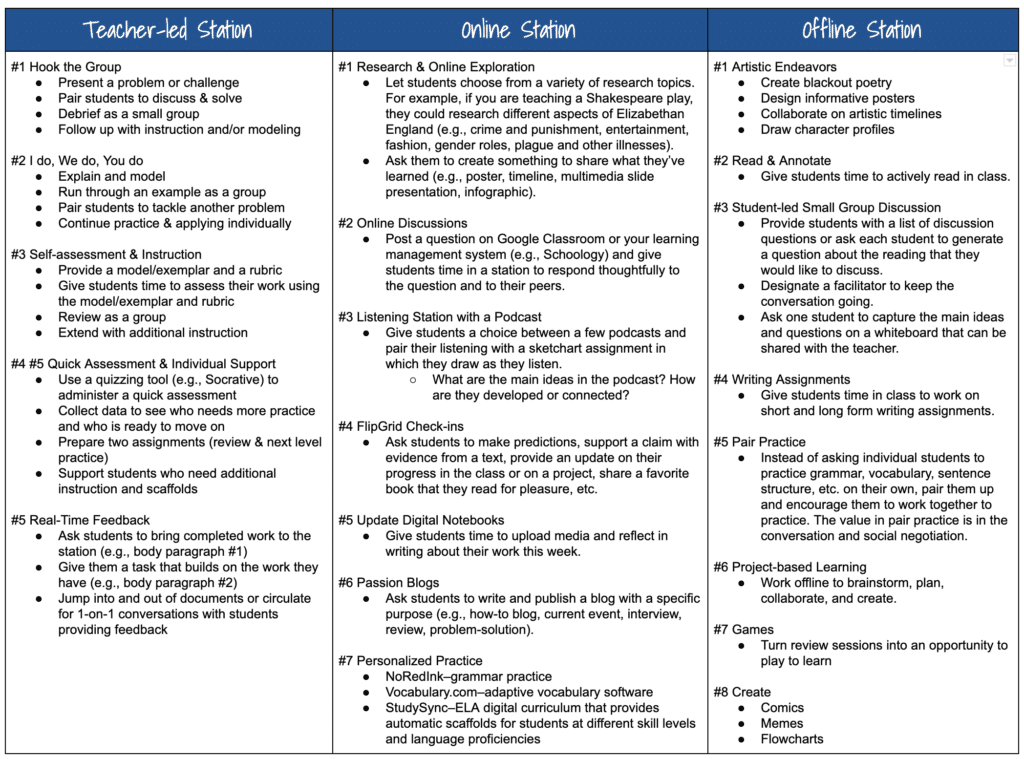
-
Texts Most Frequently Taught in US Secondary Classrooms Are Nearly Identical to List from Decades Ago NCTE 07.24.25 NCTE News NCTE Publi...
-
https://www.nytimes.com/2023/03/21/learning/thinking-made-visible-the-winners-of-our-one-pager-contest.html
-
Arpan Chokshi created a simple chart (Links to an external site.) that provides templates for 75-minute blocks for class plans for a va...

