Showing posts with label instruction & teaching. Show all posts

Friday, February 19, 2021

Developing close connections with kids - care, challenge, support, etc.

 Developmental Relationships Framework by The Search Institute

(from Marshall Memo #873)

The Minneapolis-based Search Institute created the Developmental Relationships Framework aimed at fostering “close connections through which young people discover who they are, cultivate abilities to shape their own lives, and learn how to engage with and contribute to the world around them.” The Framework has five elements, each with specific actions that make relationships powerful (quoted directly):

• Express care: Show me that I matter to you:

  • Be someone I can trust.

  • Really pay attention when we are together.

  • Make me feel known and valued.

  • Show me you enjoy being with me.

  • Praise me for my efforts and achievements.

• Challenge growth: Push me to keep getting better:

  • Expect me to live up to my potential.

  • Push me to go further.

  • Insist I take responsibility for my actions.

  • Help me learn from mistakes and setbacks.

• Provide support: Help me complete tasks and achieve goals:

  • Guide me through hard situations and systems.

  • Build my confidence and take charge of my life.

  • Stand up for me when I need it.

  • Put limits in place that keep me on track.

• Share power: Treat me with respect and give me a say:

  • Take me seriously and treat me fairly.

  • Involve me in decisions that affect me.

  • Work with me to solve problems and reach goals.

  • Create opportunities for me to take action and lead.

• Expand possibilities: Connect me with people and places that broaden my world:

  • Inspire me to see possibilities for my future.

  • Expose me to new ideas, experiences, and places.

  • Introduce me to people who can help me grow.

The Framework linked below has a checklist of specific actions that can be helpful during the pandemic.


“The Developmental Relationships Framework” from The Search Institute, 2018

Monday, February 8, 2021

The Problem with "Best Practice"

 Article: "Best Practice - the Enemy of Beteter Teaching" Link


1. "Best practices" can encourage a plug-and-play approach. Teachers are encouraged to adopt new methods and use them as often as possible, but they're often given few opportunities to analyze or develop a better understanding of those methods. For example, textbook publishers, professional development providers, and math specialists have been pushing greater use of conceptually rich mathematical problems. "Rich problems" or "concept tasks" have received the best practice label on the basis, in part, of the mistaken conclusion that higher-achieving countries teach a greater number of rich problems than the United States does.


2. "Best practices" can uncouple learning goals from instructional methods. The seven countries involved in the TIMSS used different teaching methods because they valued different learning goals. This finding reveals a principle worth highlighting: Good teaching must always be associated with a welldefined learning goal. A good teaching method for one learning goal might not be effective for another. Without specifying learning goals, there's no way to sort out which teaching methods are better than others. Suppose the goal for 10th graders taking second-year algebra is high performance on a unit test that contains a number of mathematical procedures that students must execute correctly. Research has shown that a good way to prepare students for recalling facts or procedures is repeated, error-free practice with immediate feedback. But suppose the learning goal for these same 10th graders is not just to perform well on the unit test, but to remember these procedures for the rest of the year and be able to modify them to solve slightly different problems that will come up in the future. Research has shown that this kind of learning goal is better achieved if students are required to exert some intellectual effort in making sense of the procedures, perhaps wrestling with the question of why the procedures work


3. "Best practices" focus on activity instead of achievement. In many school contexts, the idea of sharing best practices represents a search for ways to keep the classroom environment lively and stimulating. In this context, best is sometimes labeled fresh, innovative, or high interest. Although there's nothing wrong with employing high-interest activities, it's counterproductive to make them a focal point and primary objective of instruction rather than a means of fostering student learning of specific content and skills. Ends can be confused with means; activities can be substituted for achievement. Introducing new technologies is a prime example. Thousands of districts and schools have adopted one-to-one initiatives with new laptops or mobile devices and introduced interactive whiteboards, assessment clickers, and software applications, all of which are potentially powerful tools. But without careful planning and training, these devices and resources can quickly become expensive and colorful accessories for existing instructional methods— and one more reason teachers may not be focused on continual improvement of instruction through planning, trying out, evaluating, and refining better practices. The same narrative describes popular best practices, such as problem-based learning, cooperative groups, or handson activities and manipulatives. Gravitating toward the latest and greatest ideas with hopes of keeping students on task, interested, and engaged is not a bad thing. These can be effective instructional approaches—for certain learning objectives. But that nuance often is ignored, so teachers don't receive the training or aren't given the time to learn how to leverage these new approaches to foster student learning and understanding. Evaluative observations of teaching—for high stakes or not—often mistake the mere presence of specific instructional practices as meaningful, rather than attending to whether students are learning something: Did the teacher use higher-order questioning in the lesson? Yes or no? How many times? It would be better to ask, When the teacher used higher-order questioning, did it create a powerful learning opportunity? Perhaps an even more important question is this: Was the lesson planned and executed so students had challenging learning opportunities that higherorder questioning enabled?  

Wednesday, February 3, 2021

On "Social Loafing" -Getting more value from "Turn and Talk"/ The Science of Talking in Class

Getting More Value from “Turn and Talk” (from MM 826)

            In this Forbes article, author Natalie Wexler describes what she often sees in classrooms when the teacher tells students to turn and talk about something just taught:

-    Students talking about the intended topic but not making any sense;

-    Students having a lively discussion on a different topic;

-    Capable or assertive students holding forth while others listen – “social loafing”;

-    Students staring into space waiting for the teacher to say time is up;

-    A very noisy classroom, making it difficult to hear, also inviting off-task behavior.

Teachers may suspect that their turn-and-talks aren’t that productive, but many believe their administrators expect this pedagogical move to be used in every lesson.

            “To be sure,” says Wexler, “there’s truth to the idea that interaction has educational benefits. Learning doesn’t happen unless students are engaged, and group and pair work can be very engaging for students. But it’s possible to have engagement without learning.” Here are some research-based ways to get maximum value from turn-and-talks:

-    Make sure students understand what they’re supposed to be discussing, starting with enough factual information and a clear and interesting prompt.

-    Give students guidelines and protocols that help them debate and negotiate – for example, “Make sure you understand your partner’s perspective.”

-    The quality of turn-and-talks can be enhanced if students are asked to write silently before discussing with their group.

-    Pair sharing can be especially helpful in world language classes, giving students more practice using the language without the pressure of performing for the whole class.

“Why Teachers Need To Do More Than Have Kids ‘Turn and Talk’” by Natalie Wexler in Forbes, February 9, 2020, https://bit.ly/2TxOfCH 

***

Studies suggest how to guide students for productive discussions and group work

Yet when teachers open the classroom to group work and children’s chatter, peer learning can seem like a waste of time. Students often veer off-task, talking about Fortnite or Lizzo. Noise levels rise. Conflicts erupt. Are they really learning? Whether it’s productive to allot precious classroom minutes for children to talk with each other remains a debate with practical consequences.

Students didn’t always learn more from interacting with each other than working alone in the 71 underlying studies. The ones that produced the strongest learning gains for peer interaction were those where adults gave children clear instructions for what do during their conversations. Explicit instructions to “arrive at a consensus” or “make sure you understand your partner’s perspective” helped children learn more. Simply telling students to “work together” or “discuss”  often didn’t generate learning improvements for students in the studies.


source: Hettinger report: https://hechingerreport.org/the-science-of-talking-in-class/

Tuesday, February 2, 2021

Making Cooperative Learning Work Better

“Making Cooperative Learning Work Better” by Jennifer Gonzalez in Cult of Pedagogy, February 3, 2020, https://www.cultofpedagogy.com/making-cooperative-learning-work-better/

Here's Marshall Memo (#823) summary of the information:

            In this Cult of Pedagogy article, Jennifer Gonzalez recalls that when she was a middle-school English teacher, she often had students work in groups – sometimes to brainstorm ideas, sometimes as a break from the whole-class routine, and, she confesses, sometimes to lighten her grading load (30 final products versus 120).

            But cooperative work was not without its problems. Some groups didn’t stay on task, there were personality clashes, absences complicated things, and certain students ended up doing most of the work in their groups. Gonzalez began to question whether cooperative learning was adding value. Recently, she took a careful look at the research and reached out to colleagues to answer some basic questions.

            First, is cooperative learning worth it? Researchers say that it is. “In general,” summarizes Gonzalez, “when students work together, they make greater academic and social gains than when they compete against one another or when they work individually.” But cooperative learning produces these gains only when teachers orchestrate group activities to include these key elements:

-    Positive interdependence – Kids must work together to achieve a common goal.

-    Individual accountability – Each group member must do his or her part.

-    Supportiveness – Students help and encourage each other.

-    Developing interpersonal skills – Students are taught how to communicate, tackle problems, and resolve conflicts.

-    Processing – Students have time to reflect on their group’s interactions.

Implemented with these components, cooperative learning works, and it’s especially important given the demands of the 21st-century workplace, where communication, creativity, and collaboration are more important than ever. What’s more, says Gonzalez, contemporary Americans’ fixation on smartphones “is stunting our ability to have regular conversations and robbing us of all the gifts that come with those interactions. Giving students regular opportunities to share physical space and actually talk through complex problems is a gift they may not get anywhere else, so yes, it’s worth it.”

            Having established the value of cooperative work in classrooms, Gonzalez reached out for solutions to four common challenges:

            Problem #1: Uneven student contributions in groups – Quite frequently, academically stronger students do most of the work while others freeload. Or everyone works, but in “parallel play” mode, without truly collaborating. Teachers can address this problem by:

- Explicitly teaching the skills required to work well in a group. This means doing role-plays, modeling desired behaviors, and demonstrating what not to do. “Do not assume students have already been taught how to collaborate or that they should know better,” says Gonzalez. She advises starting with simple group tasks and debriefing with students. The links in her full article below include a breakdown of skills and rubrics to evaluate group work.

- Structuring the learning task so it lends itself to collaboration. Gonzalez provides links to resources for these approaches:

-    Jigsaw, in which each group member learns a discrete body of information and is then responsible for teaching it to the rest of the group.

-    Solve in Time, in which students clearly define a problem, research and understand it, come up with a solution, and share their work.

-    Kagan Cooperative Learning Structures, including Quiz-Quiz-Trade and Numbered Heads Together.

-    Team-based learning, popular in medical schools but applicable in K-12.

-    Agile Project Management, breaking large projects into shorter cycles.

-    POGIL (Process-Oriented Guided Inquiry Learning), often used in science courses.

It’s also important for the teacher to set norms and expectations up front (which might involve students creating group contracts before they get to work), spelling out procedures and roles, and what to do when there are serious disagreements.

            Problem #2: Interpersonal conflicts – Researchers have found that psychological safety is an essential prerequisite for successful group work, so it’s wise to spend time developing a comfortable group dynamic before students tackle academic tasks. Gonzalez suggests surveying students ahead of time (to avoid personality clashes that might derail a group), doing team-building activities, surveying students in the middle of multi-day cooperative projects, and actively problem-solving when issues arise (perhaps changing groups or having some students work independently).

            Problem #3: Off-task behavior – This might be excessive chit-chat, kids on their devices, or just plain fooling around. Gonzalez suggests establishing check-ins when specific tasks must be completed, using a timer for completion of certain tasks, and the teacher being self-critical about an assignment that confuses or doesn’t engage students, leading to a mid-course correction.

            Problem #4: Student absences throwing things off – “One missed day is usually not a big deal,” says Gonzalez, “but if a student misses multiple work days when the group should be actively collaborating, it becomes much harder for that person to make an equal contribution.” Her suggestions:

-    Design group projects so some parts require everyone’s involvement and others are done by individuals and collaboration might be “nice to have” rather than “must have.”

-    Be clear about individual roles and responsibilities so if a student has been absent, it’s clear what he or she must do to catch up.

-    Have groups use Google Drive or Hyperdoc, keeping the work in one cloud-accessible place so it’s possible for an absent student to contribute from home.

-    Let groups use Skype, Facetime, or Google Hangouts to chat with an absent student.

-    If a long-term absence is holding a group back, reshuffle groups or have the absent student work individually.

Gonzalez concludes with three practical tips:

-    Conduct cooperative projects in the classroom. Differences in students’ access to materials, technology, and transportation may create inequities if major collaboration is done outside of school.

-    Limit groups to 3-4 students. “Once a group gets larger than four,” says Gonzalez, “it becomes easier for students to slip through the cracks.”

-    Check out collaborative technology. Beyond Google’s tools, there are collaborative features in Trello, Asana, Kanbanchi, Slack, Wakelet, and Canvas.


Thursday, September 10, 2020

New York Times Writing Curriculum


Last year the New York Times Writing Curriculum got great.  Each unit contains prompts, daily writing prompts, guided practice with mentor texts (show don't tell, express critical opinions, quote or paraphrase experts, craft scripts for podcasts), Annotated by the Author commentaries, a contest that can be the final project, webinars.

What are the units?

 SEPTEMBER-OCTOBER

OCTOBER-NOVEMBER


Wednesday, September 9, 2020

Keeping students engaged in remote learning

https://studentaffairscollective.org/the-true-purpose-behind-student-engagement-is-the-students/

 Here’s what English teachers in the department are saying about how they’re adapting to increase student engagement in low stakes ways:

  1. The majority of teachers talked about using Zoom breakout rooms (especially with cameras on) for pairs and small groups.  One teacher added that accountability is key: “Randomly assign kids to break out rooms. Have them talk and then call them back. Then, randomly call on kids to hold them accountable.
  2. Having an informal but written product in the breakout room to share screen with the rest of the class in whole group. Collaborations in Canvas make this quick and easy for them, too. (KW)
  3. I used Poll Everything yesterday with an assignment that usually a four corners of the room assignment. So after seeing where everyone stood using the poll, I then had people take turns unmuting themselves to further explain their poll opinion. (MB)
  4. My kids are in semi-permanent learning groups. I pull each learning group, each day for small group work while the rest work asynchronously. It's not innovative, but it has been successful. (GC)
  5. I did Write-Pair-Share through Zoom which worked really well for a Fahrenheit introduction discussion. Kids had 3 minutes to write on a topic, and then I put them in breakout rooms to discuss for 5 minutes, and when we came back to the main zoom room, kids took turns sharing out what their groups discussed. Yesterday, kids had 5 minutes in breakout rooms to find a "most important passage" from the first pages of Fahrenheit. When the kids came back together, I could still see the names of students in each breakout room, so we just went through each group sharing their passages and explaining why they chose them. To review the first few pages of Fahrenheit, I told each student they had to state 1 thing they knew for sure happened, so we just went in reverse ABC order through the "zoom" room. On a day that students had to do a webquest on 3 different articles to prepare for reading, I jigsawed the activity by breaking up the class into 3 breakout rooms for those kids in the same group to read 1 article and make notes on it to share out with the rest of the class. Breakout rooms have been my saving grace to help me teach the way I usually run my classroom. I just have to keep reminding them that if something happens that I need to know about, I am available through email, but I talked myself out of fearing this function when I remembered that kids can always find ways in class in front of us to be nasty or mean to others, so it's a risk I guess I am willing to take to keep class engaging and kids producing. (JS)
  6. Canvas Groups — collaboration and conference in groups (Birthday Girl)
  7. Asking questions that require use of polls, the chat box, thumbs up, etc to show that they are actually listening and there instead of pretending like they are. (KT, LO)
  8. Have students collaborate on a Google Doc. We did an activity last week where students were all working on the same document in groups. (CB)


Tuesday, September 8, 2020

"Instructional Shifts to Support Deeper Learning" - McTighe and Silver - notes

 One big idea that highlights "the big skills" in education (and LA classrooms):

Focus less on didactic instruction and more on active meaning making by students. Students should be “earning” understanding of critical content by actively, independently processing new material using these higher-order skills.

-    Conceptualizing abstract ideas;

-    Note-taking and summarizing;

-    Comparing;

-    Reading beyond the literal meaning;

-    Predicting and hypothesizing;

-    Visualizing, graphic representation;

-    Empathizing and perspective-taking.


“Instructional Shifts to Support Deep Learning” by Jay McTighe and Harvey Silver in Educational Leadership, September 2020 (Vol. 78, #1); 

Friday, August 21, 2020

Question to teachers today: Thursday and Friday are the first days of 75-minute classes. How is that transition in planning going so far?

Here's what teachers have said after the abrupt transition to "remote" and "block" both at once:

Smoother than I expected during class with kids. Harder than I expected in planning for it.

Ok! I've learn d that asynchronous work for most (on GoGuardian) while working with a small learning group on Zoom -- that is going to be my default.

I like the 75-minute class period, but I found I planned too much. I need to adjust my expectations for the virtual environment because transitions take longer.

Fine. I over-planned but have adapted. Students preferred the 75-minute classes and time went by quickly.

Again, I wish we could have had some more formal training about this. But, this is so much better than hybrid. This is more instructional time than hybrid, and it provides stability of planning. Please, please, please convey this to the higher ups who are thinking of jumping back and forth between this and hybrid.

My general experience so far has been that I've spent more time figuring out and trouble shooting Zoom, Canvas and other delivery methods than I have on content, which is especially frustrating since I am teaching a new prep. Between the two new things, I'm about as overwhelmed as I've been in 24 years of teaching.

The class periods themselves are much nicer than rushing through an entire school day with short periods. It seems much more civilized.

The feedback from kids has been positive so far when I have checked in with them about how things are going. Many kids indicate that they like the flexibility of remote learning and that they feel less stressed than they normally do at school. Especially the honors students. They do concede to missing being in the classroom, but this definitely could bode well to offering a blended model someday when we aren't living in this nightmarish state.

I love the 75-minutes classes! It gives time to build relationships, introduce concepts, have students apply them, and provide coaching (both collective and holistic). My students are also saying they like the schedule of Block. They feel like they have time to process all that's been taught, get a pause, and then geared up for the next class. Sort of reminds me what is good about college, which is also good for students since we should be working to transition them to a schedule that requires time-management. The only thing I need to adjust for next week is to avoid going over the 75 minutes, to be respectful of their time. (Oops.)

Tuesday, August 18, 2020

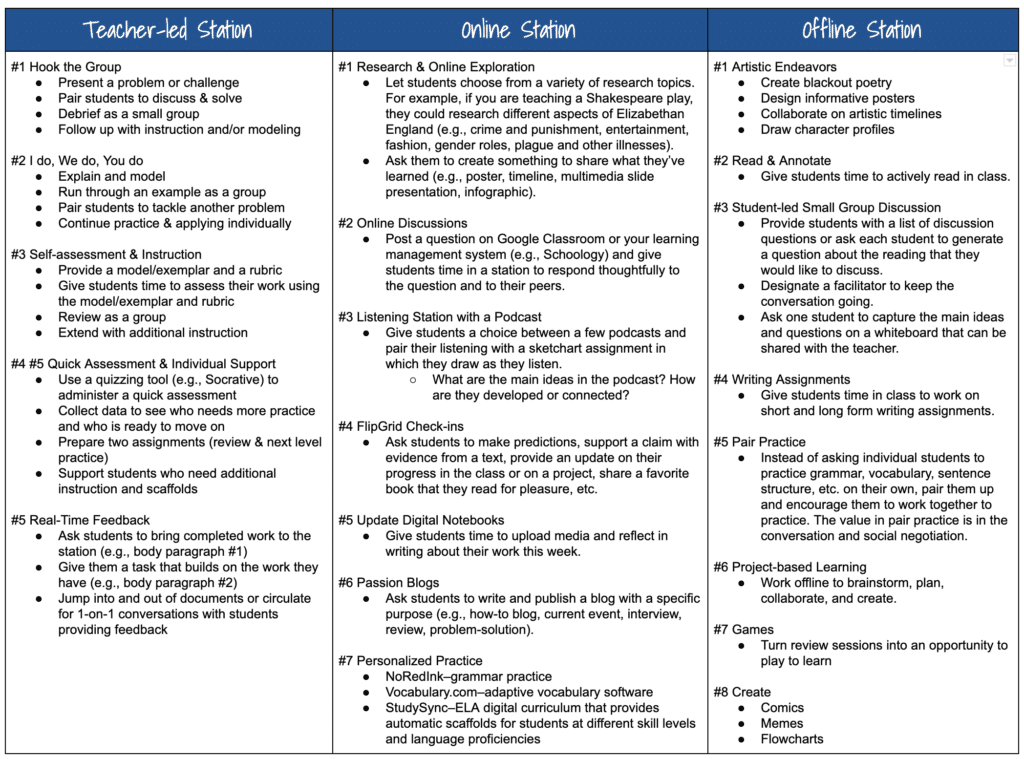
Block Schedule Ideas and Templates


Arpan Chokshi created a simple chart

 (Links to an external site.) that provides templates for 75-minute blocks for class plans for a variety of modes, like discussion, reading, writing workshop, presentations. If you like this, you can also read this post (Links to an external site.) by Tricia Ebarvia (that Arpan adapted) which contains 24 sample block schedules for reading, small group discussion, and writing workshops which could be especially useful for English teachers.   Ebarvia's reminders on screen time, cognitive load, community, and consistency were important as well. She’s posted more variations and formats of schedules here


Also check out English teacher Caitlin Tucker's web page and graphics about planning for a Station Rotation model
 (Links to an external site.) which integrates with block well.


Thursday, March 19, 2020

Habits of Mind Questions for Students (plus UbD)

from Marshall Memo 828

Essential Questions for Habits of Mind

(Originally titled “Dispositions by Design”)
            In this article in Educational Leadership, Arthur Costa and Bena Kallick (Institute for Habits of Mind) and author/consultants Jay McTighe and Allison Zmuda suggest ways to apply the Wiggins/McTighe Understanding by Design framework to Costa and Kallick’s 16 Habits of Mind. Here is a selection of Essential Questions for each of the Habits of Mind (see the full article link below for the Understandings):
• Persisting
-    Why should I keep trying?
• Managing impulsivity
-    What do I do when I am driven by emotions?
• Listening with understanding and empathy
-    How might it feel to be…?
• Thinking flexibly
-    In what other ways might I think about this?
• Thinking about thinking (metacognition)
-    What kind of thinking is called for in this situation?
• Striving for accuracy
-    How can I continue to perfect my craft?
• Questioning and posing questions
-    What questions do we need to ask?
• Applying past knowledge to new situations
-    What do I already know, and how does it apply here?
• Thinking and communicating with clarity and precision
-    What are the consequences of imprecision?
• Gathering data through all senses
-    What sources of data should I consider?
• Creating, imagining, and innovating
-    What is another way of seeing or doing this?
• Responding with wonderment and awe
-    Why is this so amazing, interesting, or mysterious to me?
• Taking responsible risks
-    What might be the effects of taking this risk – or of not trying?
• Finding humor
-    Am I taking myself too seriously?
• Thinking interdependently
-    How can we work best together? How can we avoid “group think”?
• Remaining open to continuous learning
-    What do I still wonder about?

Costa, Kallick, McTighe, and Zmuda suggest several ways the questions might be used:
-    Posting some of them in classrooms or common areas;
-    Drawing attention to a relevant question during a class;
-    Looking for an opportunity to highlight a Habit being used by a student;
-    Teachers thinking aloud about how they are using a Habit;
-    Having a Habits of Mind “show and tell;”
-    Students writing journal entries about using the Habits;
-    Before embarking on a project, having students reflect on the Habits they might use.
“By visiting and revisiting the essential questions across the grades,” say the authors, “students will come to better understand and internalize these productive mental dispositions. Ultimately, we want students to be asking these questions of themselves, without prompting. The long-range goal is for students to develop an internal compass to help them recognize the need for, and appropriately invoke, the appropriate habit(s) when confronting new challenges and opportunities, within school and throughout their lives.”

“Dispositions by Design” by Arthur Costa, Bena Kallick, Jay McTighe, and Allison Zmuda in Educational Leadership, March 2020 (Vol. 77, #6, pp. 54-59), available to ASCD members and for purchase at https://bit.ly/2x0RmeO; the authors can be reached at artcosta@aol.com, kallick.bena@gmail.com, jay@mctighe-associates.com, and allison.g.zmuda@gmail.com.