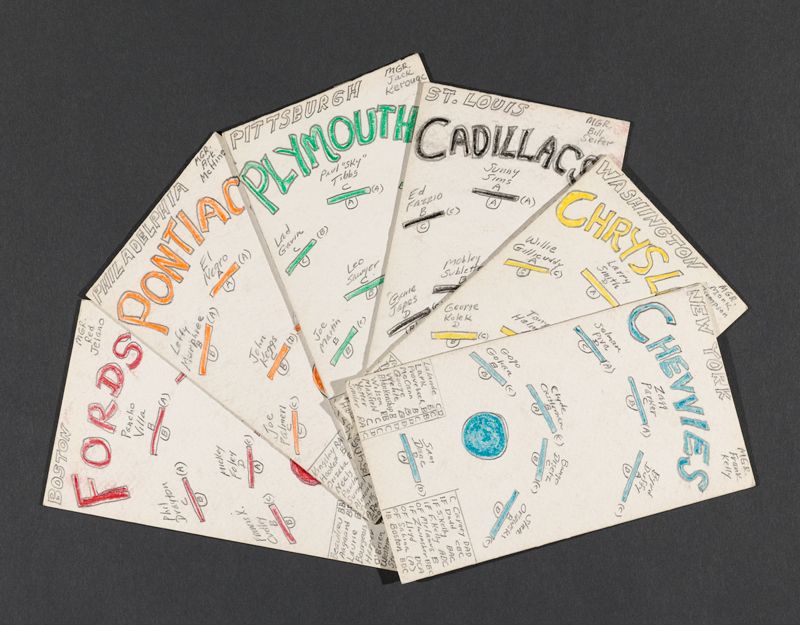
https://www.openculture.com/2015/04/jack-kerouacs-secret-obsessive-fantasy-baseball-hobby-before-fantasy-sports-became-a-phenomenon.html
https://www.openculture.com/2015/04/jack-kerouacs-secret-obsessive-fantasy-baseball-hobby-before-fantasy-sports-became-a-phenomenon.html
Parable of the Elephant
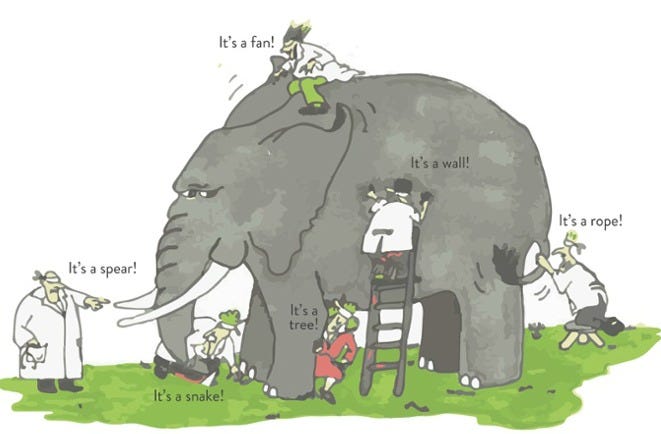
A group of blind men heard that a strange animal, called an elephant, had been brought to the town, but none of them were aware of its shape and form. Out of curiosity, they said: "We must inspect and know it by touch, of which we are capable". So, they sought it out, and when they found it they groped about it. The first person, whose hand landed on the trunk, said, "This being is like a thick snake". For another one whose hand reached its ear, it seemed like a kind of fan. As for another person, whose hand was upon its leg, said, the elephant is a pillar like a tree-trunk. The blind man who placed his hand upon its side said the elephant, "is a wall". Another who felt its tail, described it as a rope. The last felt its tusk, stating the elephant is that which is hard, smooth and like a spear.
following from here
I just love the ancient parable about the elephant. Six blind men were asked to describe an elephant by touching its body parts. The first man felt its side and described the elephant as a wall, the second man touched its tusk and thought it was a spear, the third man felt its trunk and was confident it was a snake, the fourth touched the knee and believed it was a tree, the fifth felt the ear and thought it was a fan and, finally, the sixth held the tail and assumed the elephant was a rope. None of the blind men was wrong in his analysis because each was perfectly describing the body part he touched and felt.
The problem came from their limited perception — they believed that they understood the situation, which led each of them to a mistaken conclusion. They missed the big picture — they were petting an elephant! The same applies to making data-driven decisions. When we have limited data and information, we don’t get the whole picture. And, the same is true in reverse — often when you get the big picture, you miss out on all the parts that go into its creation.
I heard this on NPR this morning, and it's really great. He has a new collection of poetry called Time is a Mother. Really beautiful (and sad) perspective on time and why it's his "job" to be vulnerable as a poet. He says his writing/poetry is "ultimately about discovery." Ocean Vuong on NPR
From Harvard Business Review
No one has time for a bad meeting. So be sure you’re not wasting people’s time, including your own, by making each meeting purposeful, inclusive (of the people who actually need to be there), and participatory. Start by inviting people to contribute to the agenda beforehand. This will increase everyone’s buy-in. Then, explain why the meeting matters before you dive into the agenda. For example, you might say, “I’d like this meeting to move us closer to a hiring decision,” or, “We have an important call to make related to next week’s product launch.” Next, divvy up roles. Whose responsibility is it to challenge ideas that are raised? Who’s the final decision-maker? Who’s the notetaker? Who’s the timekeeper? And, remember, as the leader, all eyes are on you. Set the right tone by verbally recognizing valuable ideas, keeping the scope of the meeting focused, and sustaining positivity in the face of conflicts or discussions on difficult topics. Your team will follow suit.

